
The Async Policy Rubric
While every job on Working Async is a curated async role, some are Fully Async and some are Partially Async. Learn the difference between the two labels on this page.
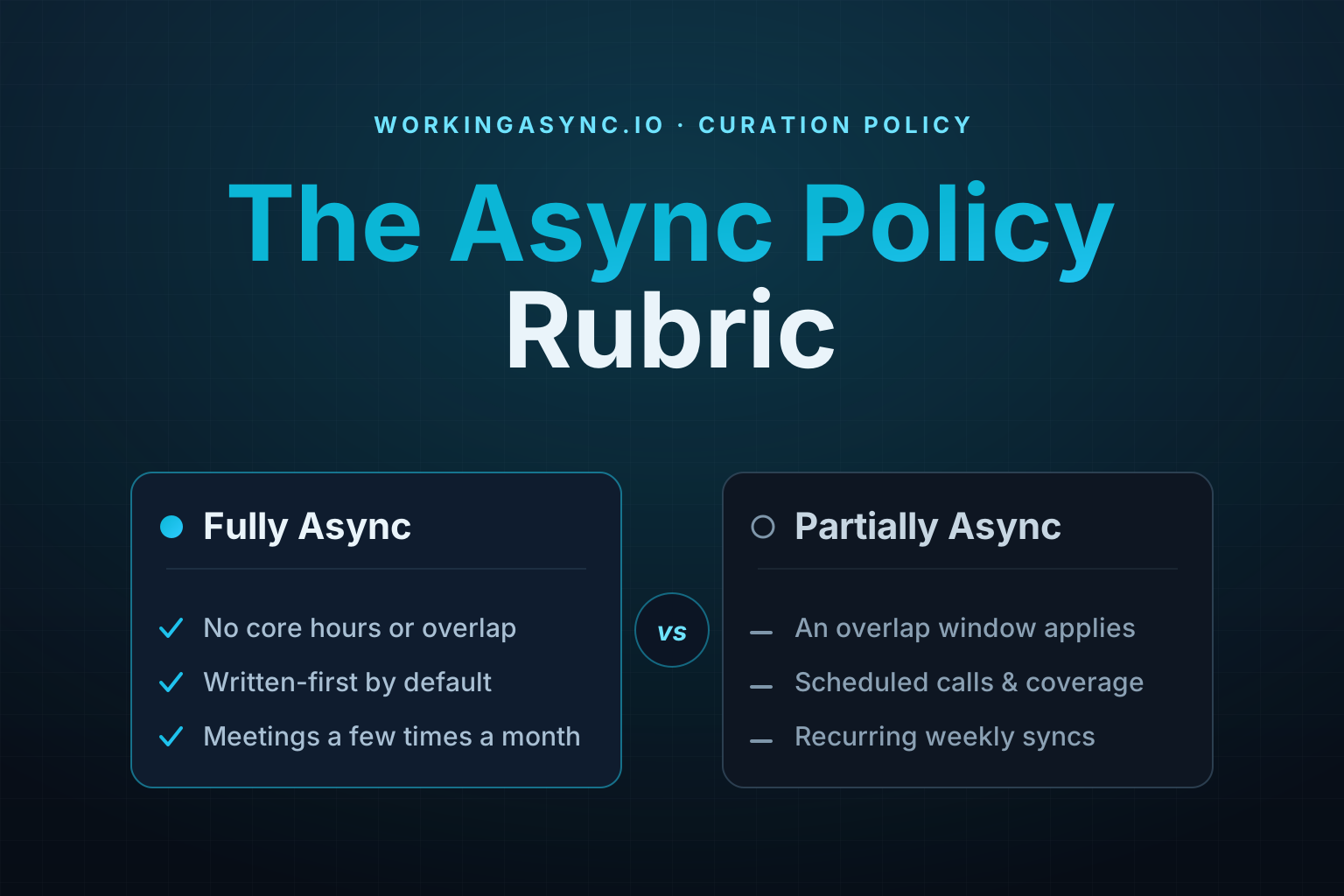
Why we label honestly
Most job boards would happily tag every remote role "async" — it's a popular word. We don't, because the label only helps you if it's earned. A sales role at the most async-first company in the world still involves scheduled calls with customers, and pretending otherwise would erode the one thing a curated board is for: trust.
So every job here carries one of two labels — Fully Async or Partially Async — assigned by the rubric below.
The rubric at a glance
| Dimension | Fully Async | Partially Async |
|---|---|---|
| Meetings | Infrequent — up to a few times a month (kickoffs, retros, occasional 1:1s or team calls), ideally optional or recorded. No daily standups, no required multiple-times-a-week syncs. | A routine part of the week — required weekly syncs, sprint ceremonies, standups, or frequent customer and stakeholder calls. |
| Core hours & overlap | None required. Timezone overlap isn't expected — or is ≤ ~2 hours and flexible in when it happens. | An expected overlap window with a team or timezone, typically 2–4+ hours. |
| Communication default | Written-first: decisions, status, and context live in docs, PRs, threads, and recorded video. Responses expected in hours, not minutes. | Async-first between commitments, but real-time conversation is a normal part of getting the work done. |
| Scheduling control | You choose your own working hours. No shifts, no on-call-by-calendar, no “be online when the customer is.” | Some scheduled availability is part of the job — demo slots, coverage windows, check-ins, or incident rotations. |
| How performance is measured | Output and outcomes — not availability or online status. | Output and outcomes, plus meeting the role's scheduled commitments. |
| Typical role functions | Engineering, design, writing, data, and other maker roles where the work ships as artifacts. | Sales, support, customer success, and other roles that inherently involve scheduled, real-time conversations. |
A job must meet all of the Fully Async criteria to carry that label. Meeting any of the Partially Async conditions — recurring required syncs, an overlap window, or a role function built on scheduled conversations — makes it Partially Async.
What "Fully Async" does not mean
Fully Async doesn't mean "never a meeting." It means day-to-day work never depends on real-time presence. Occasional synchronous touchpoints — a team call a few times a month, a quarterly kickoff, onboarding sessions, ad-hoc 1:1s — are compatible with the label. What disqualifies a role is recurring, required real-time commitments: if a standup, weekly sync, or coverage window is a routine part of the job, it's Partially Async.
The frequency difference is the point: Fully Async roles have the occasional meeting; Partially Async roles have them as a routine part of the week.
Partially Async is not a downgrade
A Partially Async role at an async-first company is still a fundamentally different job from a meeting-driven one. Outside its scheduled commitments, the work is written-first, hours are flexible, and performance is measured by output. The label just tells you, honestly, that some real-time availability comes with the territory — so you can decide whether that fits your life before you apply, not after.
A worked example
Take an Account Executive at a company whose engineers work fully async — no standups, no core hours, everything in writing. The engineering roles earn the Fully Async label. The AE role doesn't, and never will: discovery calls and demos happen on customers' calendars, which is a recurring, required, real-time commitment. It's listed as Partially Async — not because the company is less async, but because the role function caps the label. That's the rubric working as intended.
How labels get assigned
- Employer-posted jobs: employers select the policy when posting a job, against this rubric. The definitions are shown right next to the field.
- Corrections: if a listing's label doesn't match the reality of the role, tell us and we'll fix it. The rubric only works if it's enforced.
Ready to put the rubric to work?
Browse jobs by policy · Post a job · Explore async-first companies