
Asynchronous vs. Synchronous Communication: What's the Difference?
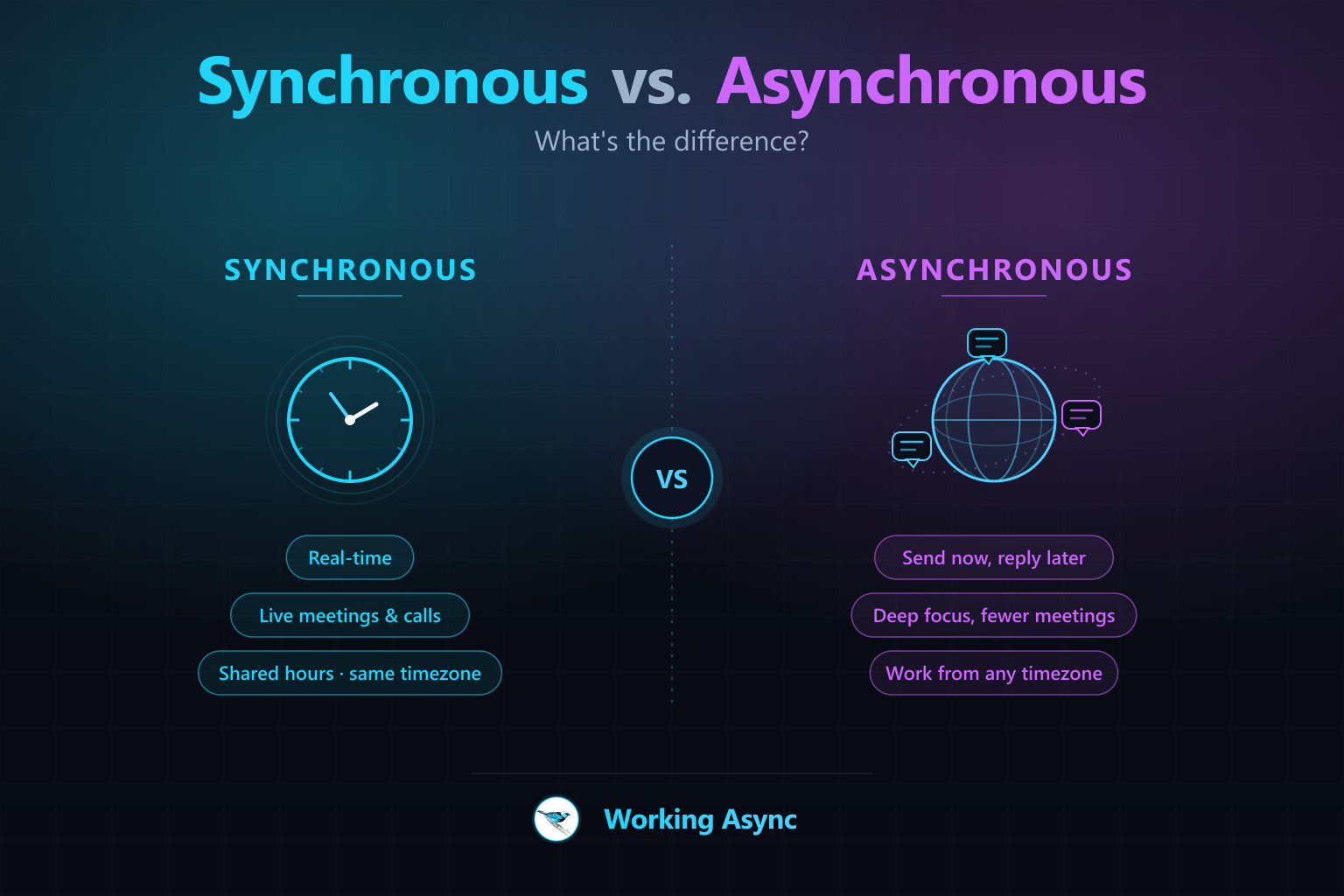
Asynchronous and synchronous communication are the two basic ways people share information at work, and the difference comes down to timing. Synchronous communication happens in real time, with everyone present at once — a video call, a phone conversation, a live chat huddle. Asynchronous communication is sent now and answered later, on each person's own schedule, with no expectation of an instant reply, like an email, a recorded Loom video, or a comment on a shared doc.
Understanding asynchronous vs. synchronous communication matters more than it seems: that single distinction shapes how many meetings fill your day, whether your working hours are fixed or flexible, and whether a team can stretch across multiple time zones at all. This guide breaks down both styles in plain terms, shows what each one looks like day to day, and helps you figure out which one fits the way you actually work.
The Short Answer: Async vs. Sync Communication
To put it simply, async communication in the workplace is not immediate and can be performed with people across the globe, while sync communication happens in real time between two or more people.
Synchronous vs. Asynchronous Communication at a Glance
| Synchronous Communication | Asynchronous Communication | |
|---|---|---|
| What it is | Communication that happens in real time, with everyone present at once | Communication sent now and answered later, with no expectation of an immediate reply |
| When it happens | Live — all parties online at the same time | On each person's own schedule |
| Common examples | Video calls, phone calls, in-person meetings, live chat huddles | Email, recorded video (Loom), shared docs, threaded comments, project management updates |
| Tools you'll use | Zoom, Google Meet, Slack huddles, phone | Email, Loom, Notion / Google Docs, Asana / Trello / Linear |
| Expected response time | Immediate | Within a few hours or by the next workday |
| Your hours | Fixed — online when the team is | Flexible — work when you're most productive |
| Time zones | Overlap with the team required | Largely time-zone independent |
| Focus & deep work | More meetings, more interruptions | Longer uninterrupted focus blocks |
| Best for you if… | You value fast feedback, live brainstorming, and hands-on mentorship | You value flexibility, deep focus, and working across time zones |
| Watch out for | Meeting fatigue, rigid hours, time-zone lock-in | Slower answers, fewer live moments, needs strong written communication |
What Is Synchronous Communication?
Synchronous communication is any exchange where everyone takes part at the same moment. The conversation only moves forward while both people are present and paying attention — so timing is everything.
Examples of synchronous communication
In the workplace, synchronous communication usually works via live meetings or ongoing chat sessions. People hop on video platforms like Google Meet or Zoom, or fire rapid back-and-forth messages in a Slack huddle, expecting a reply within seconds. The same tool can swing both ways: a live Slack huddle is synchronous, while a Slack thread you answer two hours later is asynchronous — what matters is whether an immediate response is expected, not the app itself.
What synchronous work feels like day to day
Day to day, synchronous communication can sometimes mean having a 1-hour standup meeting every day. On top of that, synchronous-heavy teams require being in the same time zone and are very prone to interrupting their coworkers. These meetings can pile up after a while and can cause employees to burn out, without actually being able to focus on their work. Lastly, it makes it very difficult to have a good work-life balance when you are required to be in meetings constantly.
What Is Asynchronous Communication?
Asynchronous communication is any exchange where you send a message now and the other person responds when it suits them. There's no expectation of an instant reply, so the conversation can stretch across hours or even days without anyone being "on" at the same time.
Examples of asynchronous communication
To properly implement asynchronous communication at a company, you should be using the correct tools to communicate. Oftentimes this can mean using Slack for messaging, Jira for tracking issues on tickets, and sending recorded videos with Loom.
What async work feels like day to day
In practice, async work means having flexible working hours for teams, and having regular deep-work blocks scheduled. When working at async teams, people are encouraged to block off 4–6 hours of work daily which they can dedicate to deep work. This means that written communication is the default, and documentation is very important. When implemented properly, it allows teams to work in practically any time zone in the world.
Sync vs. Async Communication: Side-by-Side Examples
Here's what synchronous vs. asynchronous communication looks like across the same five everyday tasks:
| Scenario | Synchronous communication | Asynchronous communication |
|---|---|---|
| Daily status update | Everyone joins a live morning standup on Zoom and takes turns sharing progress and blockers. | Each person posts a written standup in Slack or the project tool by 10 a.m., read whenever teammates log on. |
| Quick question | You message a teammate mid-call or hop on a huddle and get an answer within seconds. | You drop the question in a channel or doc comment; they reply when they next surface from focus work. |
| Brainstorming | The team meets on a live whiteboard call, riffing on ideas and building on each other in real time. | Everyone adds ideas to a shared FigJam or Notion board over a day or two, on their own schedule. |
| Making a decision | The group debates the options in a meeting and reaches agreement before the call ends. | A written proposal collects comments and approvals over a couple of days, leaving a clear record. |
| Feedback & review | You walk through the work together on a live call and discuss changes on the spot. | Reviewers leave inline comments on a pull request or Google Doc that the author addresses when ready. |
Pros and Cons for Job Seekers
Why async appeals to job seekers
As a job seeker or employee at an async company you can benefit from massive perks that regular remote-first companies will not provide. For example, you will have the liberty to choose the time zone that you work in and could travel to different continents to work while not having to be a night owl. Another huge benefit is that you can do things like have lunch with a friend or pick your child up from school in the middle of the work day. This flexibility to choose your own working hours is very valuable. Finally, fewer meetings means less pressure to be "on" — no back-to-back video calls, and far less of the camera-on fatigue that drains synchronous teams.
Where synchronous still wins
There are still many benefits to synchronous communication, like having faster response times, easier onboarding and mentoring for people earlier in their career, and brainstorming that can be easier in real time.
The honest trade-offs
With everything in life there are trade-offs when making a decision, and this means there are also trade-offs to working asynchronously. For example, asynchronous communication means slower response times in return for less meeting fatigue. You are also trading meetings for autonomy.
Which Communication Style Is Right for You?
For many professionals, it is simply not possible to adopt an asynchronous working culture due to the nature of their work. For example, 911 dispatchers, police officers, doctors, and customer service agents are all tied to working synchronously.
However, if you thrive in deep, flow-like states of work and are good at communicating via writing, there is a good chance that you and your colleagues would thrive by implementing asynchronous communication standards. The professions that benefit from asynchronous communication the most include Product Managers, Technical Writers, and Software Engineers & Developers. And because async companies hire globally rather than within one city or country, far more of these roles are open to you — wherever in the world you happen to live.
How to Tell If a Job Is Async or Sync Before You Apply
Most companies won't spell out their communication style, but the listing usually gives it away. Phrases like "async-first," "documentation-driven," or "low-meeting culture" — and tools like Notion, Linear, or Loom — signal an asynchronous team. "Must overlap 4 hours with PST," "available 9–5 EST," or "daily standups required" signal a synchronous one.
The interview is another tell: written take-homes and recorded responses lean async, while back-to-back live panels lean sync. When you're unsure, ask what a typical day's meeting load looks like, or check the company's careers page or public handbook.
On Working Async, you don't have to decode any of this — every role is listed because the company actually works asynchronously, so you can filter for fully async jobs and browse async-first company profiles without guessing.
Find Roles That Match How You Work
If flexible hours, fewer meetings, and the freedom to work from any time zone sound like the way you want to work, that's exactly what Working Async is built for. Every job on the board comes from a company that communicates asynchronously by default — no hidden 9-to-5, no surprise standups.
→ Explore the companies behind them
Frequently Asked Questions
Is Slack synchronous or asynchronous?
Both, depending on how it's used. A live Slack huddle where everyone expects instant replies is synchronous; a message posted in a thread that people answer hours later is asynchronous. The tool is flexible — the response expectation is what decides.
Is email synchronous or asynchronous?
Email is asynchronous. You send it whenever you like, and the recipient replies on their own schedule, with no expectation of an immediate response.
Is asynchronous communication better than synchronous?
Neither is universally better — they suit different kinds of work. Async shines for deep, focused work across time zones, while sync is faster for live problem-solving, brainstorming, and mentoring. Most teams use a mix of both.
What is an example of asynchronous communication?
Sending a recorded Loom walkthrough, leaving comments on a shared Google Doc, posting a written standup in Slack, or opening a ticket in Jira are all asynchronous — the recipient responds when they're available.
Can a job be fully asynchronous?
Very few jobs are 100% async, but many are "async-first," meaning meetings are rare and most work happens in writing. These roles still use the occasional live call for the moments that genuinely need one.
Which jobs are best suited to asynchronous communication?
Roles built around focused, independent output fit async best — Product Managers, Technical Writers, and Software Engineers and Developers are common examples. Jobs that need real-time presence, like 911 dispatchers or customer service agents, are much harder to do asynchronously.