
Hiring Internationally: An Employer of Record Guide
You found the right person. They live in Lisbon, or São Paulo, or Manila. Then you get to the part nobody warned you about: how do you actually put them on payroll?
Here's the thing most founders get backwards. If your new hire lives and works in their own country, your country's immigration law never enters the picture. The rules that decide what you can and can't do are the employment laws of the country they live in. Visas, sponsorship, and work authorization only matter if you're moving someone across a border.
That's a much smaller problem than it sounds like — and it's already been solved.
Hiring async-first talent? Post a remote async job →
Disclosure: Working Async earns a referral commission from some of the providers named in this post — currently Deel. It costs you nothing extra, and it doesn't decide what goes in here: the comparison below is the same one we'd write if none of them paid us. Read our full affiliate disclosure.
The Short Answer: Three Ways to Hire Someone in Another Country
Strip away the jargon and there are only three real routes.
Hire them as an independent contractor. They invoice you, they handle their own taxes, and nobody is anyone's employee. Fast to set up, and risky if the relationship actually looks like employment.
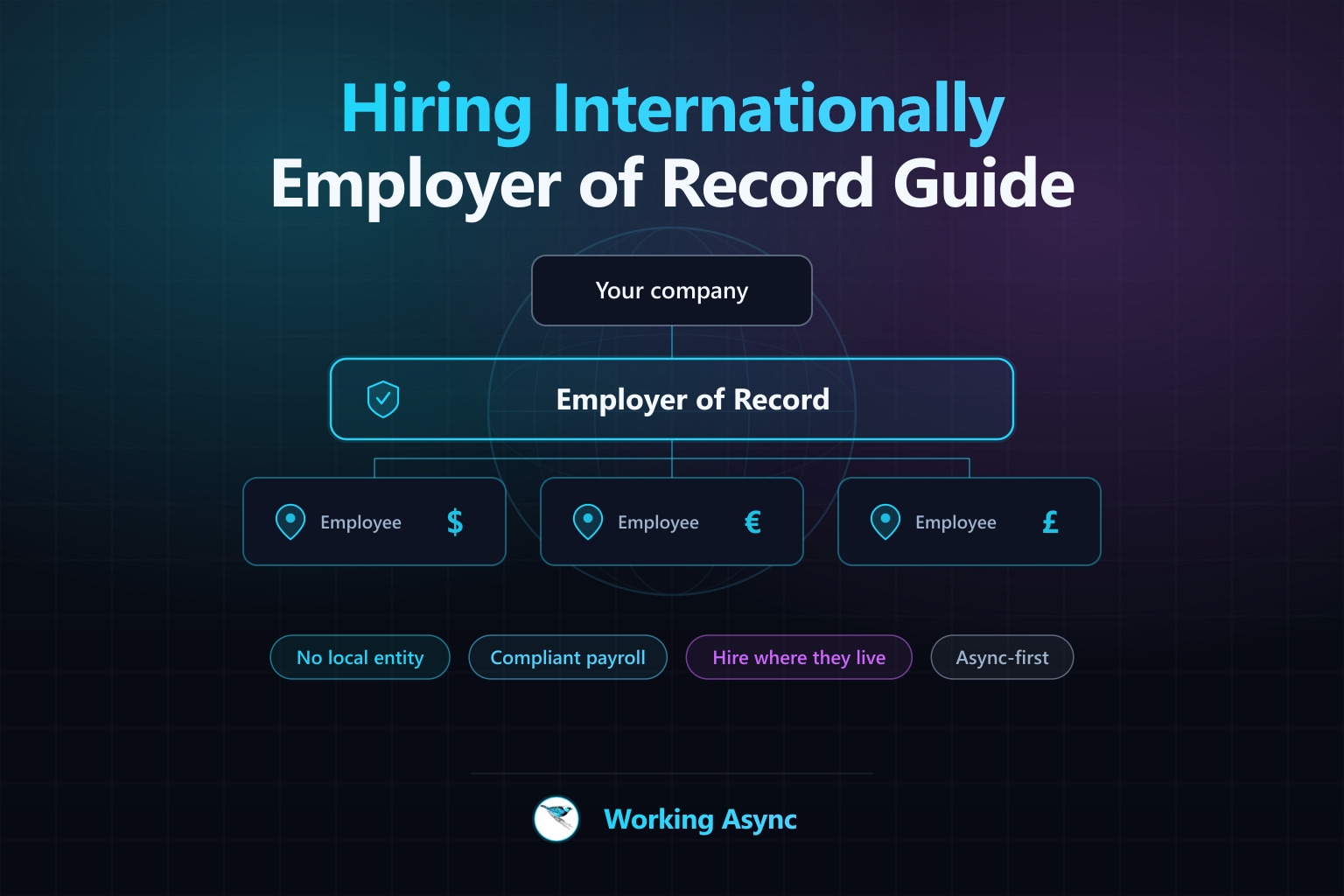
Use an employer of record. A company that already has a legal entity in their country employs them on paper, on your behalf. You get an employee without registering a business abroad.
Open your own local entity. You register a real company in their country and hire directly. Maximum control, maximum overhead.
A fourth option gets mentioned a lot and usually shouldn't be: a PEO, or professional employer organization, which co-employs alongside you. It only works if you already have an entity there, which is exactly the problem you're trying to avoid.
| Approach | Who's the legal employer | Need a local entity? | Best when |
|---|---|---|---|
| Independent contractor | Nobody — they invoice you | No | Short, defined, project-shaped work with a genuinely independent worker |
| Employer of record (EOR) | The EOR's local entity | No | You want a real employee in a country where you have no presence |
| PEO / co-employment | You, jointly with the PEO | Yes | You already have an entity there and want to outsource HR and payroll admin |
| Your own entity | You | Yes — you build it | Enough headcount in one country to beat the setup and accounting cost |
What Is an Employer of Record?
An employer of record is a company that already has a legal entity in your hire's country and employs that person on your behalf — so they get a compliant local contract, local payroll, and local benefits without you registering a business there.
They're the employer on paper. You're still the boss in practice. You pick the person, set their work, run their reviews, and decide when the relationship ends.
What the EOR carries:
- A local employment contract in the right language, under the right law
- Payroll, tax withholding, and social contributions filed locally
- Statutory benefits — health coverage, pension, paid leave, parental leave
- Employer-side registrations and filings you'd otherwise have to do yourself
- Termination paperwork, notice periods, and severance calculations
- Sometimes visa and relocation support, if you ever do need it
What an EOR Does Not Do
This is worth knowing before you start shopping, because the marketing pages blur it.
An EOR doesn't make someone eligible to live or work somewhere they aren't already allowed to be. It doesn't set your pay bands or tell you what a fair local salary is. It doesn't manage performance, and it won't fire someone for you because you're avoiding a hard conversation.
And it doesn't take your classification risk off the table entirely. More on that below.
What Does an Employer of Record Cost?
Published prices go stale fast and quoted prices vary by country, so it's more useful to know the shape of the bill than a number. There are three buckets.
The provider's fee. Either a flat amount per employee per month, or a percentage of salary. These price very differently at the top end — a percentage model on a senior salary can cost several times what a flat fee does for the same person.
Employer-side taxes and statutory contributions. Billed at cost, on top. In some countries these add a substantial fraction to the salary figure before anyone's service fee is applied, and it's the line that blows up budgets built from base salary alone.
Deposits and currency. Many providers require a deposit or prefunding, and every one of them converts currency at some rate. Ask which rate, and when it's locked.
Ask which of those three buckets a quoted number includes. A quote that only covers the first one isn't a quote.
Permanent Establishment Risk: The Part Most Founders Miss
Permanent establishment is a tax authority deciding that your company is doing enough business inside their country that it should be taxed there.
You never registered anything. You've never visited. It doesn't matter — the test is about activity, not paperwork.
What tends to trigger it:
- Someone habitually negotiating or concluding contracts on your behalf in that country
- Local sales activity being run from there
- A fixed place of business — an office, a warehouse, sometimes a long-term home setup you pay for
- Someone senior enough that they're effectively directing the business from there
The consequence is corporate tax registration, filings, and potentially back taxes and penalties, in a country where you have no lawyer and no accountant.
A full-time "contractor" in Germany closing deals for you is the textbook version of this.
Hiring through an EOR is the standard way to reduce this exposure, because the person is employed by an entity that's already tax-resident there. Be clear on what that means though: it reduces the risk, it doesn't vaporize it. If you're putting a sales leader or a country manager abroad, that's worth an actual tax opinion, not a blog post.
Misclassification: The Other Expensive Mistake
Calling someone a contractor doesn't make them one. Most countries look at how the relationship actually works, not at what the contract says.
Red flags:
- They work hours you set
- They use your equipment and your accounts
- They have no other clients
- The engagement is open-ended with no defined deliverable
- They're doing core business work, not a specialist project
- They're in your org chart and report to a manager
If a regulator reclassifies them, it's retroactive: back payroll taxes, back social contributions, back benefits, and statutory severance calculated from their real start date. That bill lands years later, usually at the worst possible time.
How to Pay International Employees
Here's a distinction that costs people real money: a global payroll provider is not an employer of record.
A global payroll provider runs payroll for entities you already own. An employer of record is the employer. Founders shop these interchangeably, buy the payroll product, and then discover it can't employ anyone for them.
Once you've got the right product, the mechanics still need decisions.
Currency. Pay in your currency or theirs? Paying in theirs is kinder and usually expected, but someone absorbs the exchange rate movement. Decide who, and write it down.
Cadence. Monthly is standard in much of the world, which may not be the rhythm your own team is used to. Your hire's rent is due on their country's schedule.
Mandatory extra months. A number of countries require a thirteenth month of pay, and some require a fourteenth. It's statutory, not a bonus you get to decide on.
Total cost, not salary. The number you should be comparing across countries is salary plus employer contributions plus the provider's fee. Comparing base salaries alone will lead you to the wrong conclusion about where hiring is cheap.
The Honest Trade-Offs of Hiring Through an EOR
An EOR is the right answer for a lot of teams. It is not a free lunch, and the downsides are real.
It's a per-head cost, forever. Fine for one or two people. At around five in the same country, your own entity often becomes cheaper — and the math only gets more lopsided from there. Run it before you're twenty deep and locked in.
You're not the legal employer. That leaks into places you don't expect: equity grants, background checks, IP assignment paperwork, and which system is the real source of truth for HR data. None of it is fatal. All of it takes work.
Nowhere else is at-will. Notice periods, statutory severance, works councils, protected categories you've never heard of. Ending an employment relationship in most of the world is a process with steps and timelines, not a decision you make on a Friday.
"Countries covered" is doing a lot of heavy lifting. Providers own entities in their core markets and work through partner entities everywhere else. A partner entity means a different support chain, different contract paper, and sometimes different IP terms than the ones you were shown. Ask which one your specific country is. This is the single most useful question in this post.
Switching is painful. Moving people from one provider to another — or off an EOR onto your own entity — is a termination and a re-hire in most jurisdictions. New contracts, new notice clocks, and in some places lost tenure for the employee. Choose like you're going to stay.
How to Choose an Employer of Record
Every provider's site says the same six things. These are the questions that actually separate them.
- Do you own an entity in the specific country I'm hiring in, or is it a partner?
- Exactly what's included in the per-employee fee, and what's billed at cost on top?
- Is there a deposit or prefunding requirement, and what exchange rate do you convert at?
- Who carries the severance liability at termination, and what does your process look like?
- Does your local contract assign IP to me, and is the confidentiality clause enforceable there?
- Are the benefits statutory minimum, or locally competitive? Can I upgrade them?
- If I open my own entity in eighteen months, how do you transfer my people out?
- Who answers when payroll is wrong on a Friday, and how fast?
Get the answers in writing. The gap between the sales call and the contract is where the surprises live.
Deel, Oyster, and Remote: How the Three Big EORs Compare
These are the three names you'll hit first, listed alphabetically, not ranked. None of them is the right answer for everyone, and which one fits depends almost entirely on which countries you're hiring in.
| Provider | Built around | Stands out for | Ask before you sign |
|---|---|---|---|
| Deel | The widest product surface — EOR, contractors, global payroll, immigration, its own HR system | Being the one-stop default, with the deepest bench of adjacent products | Which of your target countries are owned entities versus partners, and how much you're being cross-sold |
| Oyster | An EOR-first product for globally distributed teams | Self-serve onboarding and coverage in places rivals treat as long-tail | Depth of the surrounding HR and payroll stack, if you need it for your home country too |
| Remote | An owned-entity model it markets heavily | Consistency of contract paper and support in the countries where it owns the entity | Whether your specific country is on the owned list — and what changes if it isn't |
Deel is the broadest of the three. If you want contractors, employees, payroll, and equipment in one place, that breadth is genuinely useful. The flip side is that breadth means more surface to evaluate and more products being pitched at you — go in knowing which one you actually came for.
Oyster is narrower and easier to get moving with, particularly if the EOR is the whole reason you're shopping. If you also need a full HR system for your home-country team, check how much of that you'd still be buying elsewhere.
Remote markets an owned-entity model as its differentiator, and where that holds it means one company answering for the contract, the payroll, and the support. The question to ask is whether it holds in your country, because no provider owns an entity everywhere.
All three are async-first employers themselves, which is why they're on this board. You can see what they're hiring for right now: Deel, Oyster, and Remote.
Country by Country: What Surprises People
Every country has one or two rules that catch first-time employers off guard. These aren't legal advice and they change — treat them as things to raise with your provider before you budget.
- United Kingdom — Right-to-work checks have to happen before the first day, not after. Pension auto-enrollment starts then too: staff get assessed from the beginning, and anyone eligible is enrolled within a set window.
- Canada — Employment rules are set province by province rather than nationally, apart from a few federally regulated industries. Hiring in Ontario and hiring in Quebec are two different jobs.
- India — Provident fund contributions and long-service gratuity can add a lot to what someone actually costs you. Budget from the loaded figure, not the salary.
- Philippines — Thirteenth-month pay is required by law for most private-sector staff. It's not a bonus you get to decide on.
- Singapore — CPF contributions apply to citizens and permanent residents, not to foreign hires as a rule.
- Netherlands — Ending a contract is genuinely hard here. The 30% tax ruling for qualifying incoming employees has changed and comes with transition rules, so check what applies now rather than what you read a year ago.
- Australia — The superannuation guarantee is compulsory, but contracts differ on whether quoted pay includes it or sits on top — check which. Long service leave builds up over years of service, and the rules vary by state.
What If You Want to Sponsor Someone to Live in the United States?
Different problem entirely.
If you need someone to physically relocate — to the US, or to wherever you're based — that's immigration: visa categories, sponsorship, quotas, and timelines measured in months or years. No employer of record can manufacture work authorization, and any provider suggesting otherwise is one to walk away from. That conversation starts with an immigration attorney.
But it's worth asking whether you need it at all. If the person can stay where they are and do the job well, the entire problem dissolves — which is the actual reason async-first companies hire this way in the first place.
Hiring Globally Only Works If the Work Is Actually Async
An EOR solves your legal problem. It does nothing about the fact that your new hire in Manila is asleep during your 10am standup.
This is where global hiring quietly fails. A company hires across eight time zones, keeps running on live meetings, and either burns out the people furthest from headquarters or slowly stops inviting them to anything that matters. The compliance product was never going to fix that.
Working in writing is what makes distance survivable — decisions in documents, updates people can read when they wake up, and a default that progress doesn't wait for a call. If that's new to your team, start with what asynchronous communication actually is and the practical async versus synchronous comparison.
Then be honest about where you land. Our async rubric is the standard we hold listings to, and it's a fair self-assessment before you go hire someone twelve hours away.
Frequently Asked Questions
Can I hire an employee in another country?
Yes. The catch is that you can't usually employ them directly without a legal presence in their country, so you either use an employer of record, engage them as a genuine contractor, or register a local entity. Their country's employment law governs the relationship, not yours.
Do I need to open a company in their country to hire someone there?
Not if you use an employer of record — that's the entire point of the model. You'd open your own entity when headcount in one country grows enough that per-employee fees stop making sense, which for most teams is somewhere around five people.
What's the difference between an employer of record and a PEO?
An EOR is the legal employer through its own entity, so you don't need one. A PEO co-employs alongside you, which means you must already have a registered entity in that country. If you don't, a PEO can't help you.
How much does an employer of record cost?
Providers charge either a flat monthly fee per employee or a percentage of salary, and employer-side taxes and statutory contributions are billed on top at cost. Ask for a total landed cost for a specific salary in a specific country — headline fees leave out the part that actually moves your budget.
How long does it take to hire someone abroad through an EOR?
Onboarding is typically days to a few weeks once you've picked a provider, depending on the country and how fast local registrations clear. The slow part is usually choosing the provider and getting your own legal and finance teams comfortable, not the setup itself.
How do I hire someone from another country to work in the USA?
That's an immigration question, not an employment-structure one, and it needs visa sponsorship with its own eligibility rules and timelines. An employer of record cannot create work authorization. Talk to an immigration attorney before you make an offer.
Can employees legally work remotely from another country?
It depends on where they're a tax resident and what their immigration status allows — being allowed to do a job isn't the same as being allowed to do it from a given country. Long stays can create tax obligations for the employee and permanent establishment exposure for you, so agree the rules in writing before anyone books a flight.
Which employer of record is best?
There isn't one. The right provider is whichever owns an entity in the countries you're actually hiring in, at a total cost you've seen in writing. Shortlist two or three, ask them all the same questions, and compare the answers rather than the marketing.
Hire the Person, Not the Time Zone
The legal side of global hiring is a solved problem with a few good vendors and a handful of questions worth asking carefully. The harder part is building a team that works well when people aren't online at the same time — and that's the part Working Async exists for.
→ Post a role and reach async-first candidates
→ See the async-first companies already hiring worldwide
→ Browse what worldwide remote roles look like today
The best person for the job probably doesn't live where you do. Where they live doesn't have to decide whether you hire them.