
Async Companies: How They Work and Who's Hiring Now
Somewhere right now, a company is making a good decision in a meeting nobody recorded, and in six months nobody will remember why they made it.
At an async company, that decision would live in a document — proposed in writing, debated in comments, findable forever by anyone who joins later. That's the whole idea: asynchronous companies are businesses that run on written artifacts and measurable output instead of shared hours and live presence.
For you, the difference is concrete: your calendar mostly belongs to you, your work speaks in writing, and your time zone stops being a hiring filter.
What Is an Async Company?
An async company is one where work moves forward without requiring people to be online at the same time. Decisions happen in documents. Updates are written, not performed in standups. Meetings still exist — but as a deliberate exception with a cost, not a default with momentum.
Async is the strictest tier of remote culture. Plenty of companies are remote; far fewer have removed the shared-schedule assumption itself. (Our breakdown of remote-first companies maps all three tiers — remote-friendly, remote-first, async-first.) And if the underlying communication style is new to you, start with what asynchronous communication actually means.
How to Recognize a Genuinely Async Company
Marketing pages all say "flexible." The real signals are structural:
- A written source of truth. A handbook, RFC process, or decision log that actually gets used — the company's brain in documents, not in someone's memory.
- Wide or worldwide hiring bands. A company hiring across every time zone has no choice but to run async. Narrow "core hours" requirements tell you the opposite.
- Meetings with agendas, notes, and audits. Live time is spent like money, and recurring calls get cancelled when they stop earning their cost.
- Reviews that cite shipped work, not responsiveness, visible hours, or green status dots.
These signals are the backbone of the async rubric we screen every employer against before it reaches the board.
Five Async Companies Hiring Right Now
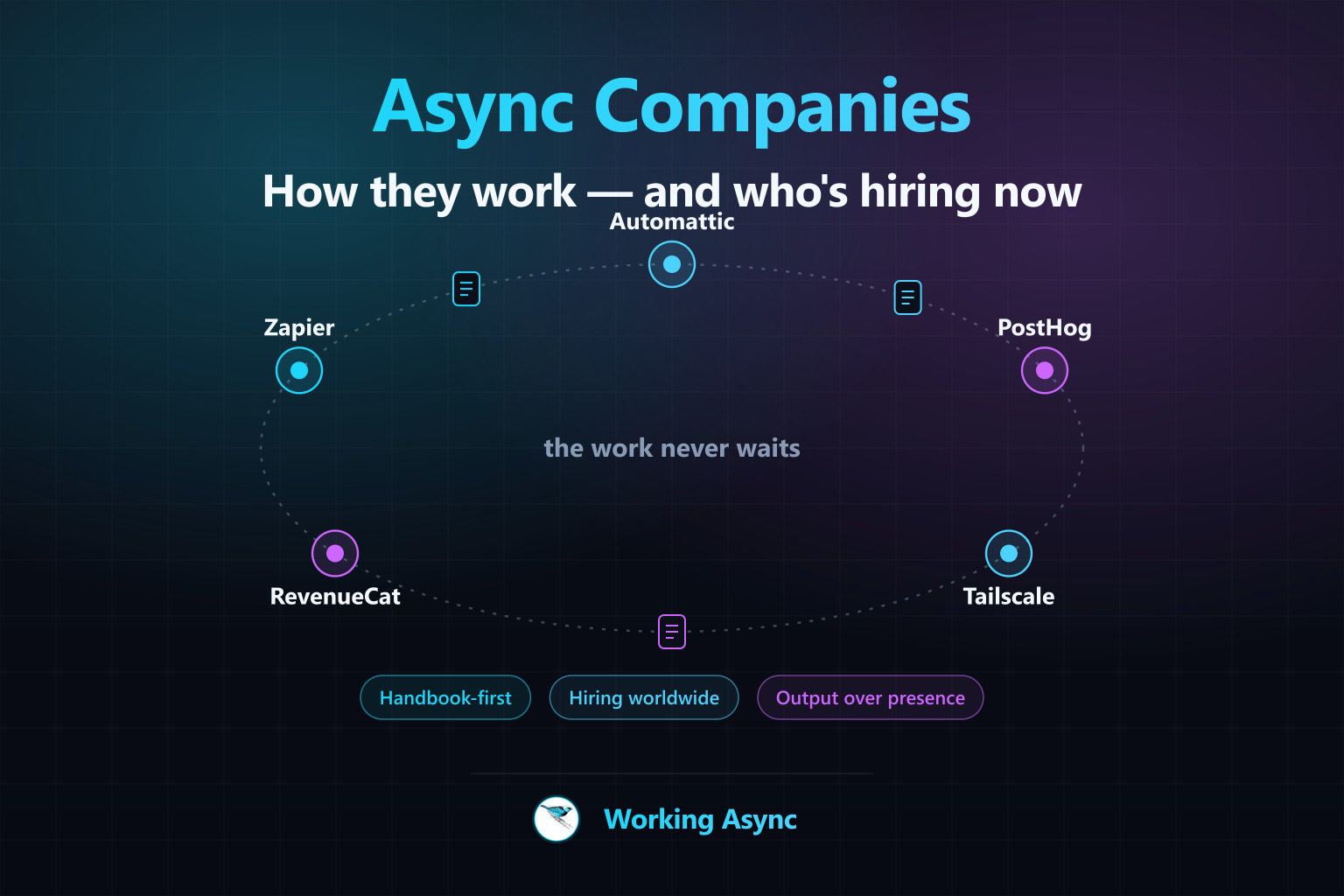
All five below are recent additions to the Working Async board, all fully distributed, and all vetted for genuinely asynchronous culture:
Zapier
The automation platform has been fully remote since its earliest days — no offices, a team spread across dozens of time zones, and an internal culture famous for written updates and documented decisions. Fitting, really: a company whose product removes repetitive busywork runs itself with as little synchronous busywork as possible.
Automattic
The company behind WordPress.com and WooCommerce has been distributed for roughly two decades — long before "remote-first" was a phrase. Internal communication happens on threaded posts rather than in meetings or email chains, which means the context behind almost any decision is a search away. Every listing on its board is simply "Remote."
PostHog
The open-source product analytics company runs all-remote with a public handbook and small, autonomous teams that ship without waiting for permission. Its transparency is the async tell: when your strategy, process, and salaries are written down in public, you don't need a meeting to find out what's going on.
Tailscale
The secure-networking company (built on WireGuard) grew out of deeply technical, documentation-heavy engineering culture and hires remotely, with much of the team across North America. Infrastructure work rewards exactly what async culture produces: careful written design and decisions you can audit later.
RevenueCat
The in-app subscription platform runs remote-first and hires across the Americas and EMEA. Developer-tool companies like this live and die by their documentation — and that same written-first muscle powers how the team itself works.
They join a board that includes GitLab — the all-remote reference implementation, public-handbook and all — plus DuckDuckGo, Supabase, Remote.com, and more. Roles across all of them span engineering, product, marketing, and support.
The Trade-Offs of Joining an Async Company
With everything in life there are trade-offs, and async companies ask real things of the people who join them:
Drawbacks:
- Writing carries your career. Your ideas travel exactly as far as your ability to write them down. Weak writing at an async company is like a quiet voice in a loud room.
- Feedback loops stretch. Waiting hours for an answer is normal. You'll need the judgment to keep moving without one — and the humility to flag when you guessed wrong.
- Connection takes intent. There's no hallway. Retreats and social calls exist, but belonging is something you opt into, not something that happens to you.
- The applicant pool is planetary. The same worldwide hiring that opens these doors to you opens them to everyone else, too. Expect competition.
How to Get Hired at an Async Company
- Make the application your proof. Async companies hire through writing, so a clear, self-contained application is the audition. Generic ones demonstrate the opposite of the job's core skill.
- Bring async evidence. A documented project, a well-run open-source thread, a decision memo, a public portfolio walkthrough — anything that shows you can move work forward without a meeting.
- Audit them back. Ask where the last significant decision is written down. A real async company answers with a link. A meeting-driven one answers with a story.
- Fish where the async fish are. Skip guessing on general boards — the live listings on Working Async only come from companies that already passed the rubric.
Frequently Asked Questions
What is an async company?
A company designed so work progresses without everyone being online together: decisions in documents, updates in writing, meetings as a rare deliberate exception, and performance measured by output instead of hours or availability.
Which companies work asynchronously?
Well-known examples include GitLab, Zapier, Automattic, PostHog, Tailscale, and RevenueCat — all fully distributed employers that lean on handbooks and written communication, and all listed on the Working Async board.
Are async companies fully remote?
Almost always, since async culture makes offices optional by design. But the reverse isn't true — many fully remote companies still run on synchronous meetings. Async is a cultural choice on top of remote, not a synonym for it.
Do async companies pay less?
No — async describes how a company coordinates, not what it pays. The companies above compete for global talent in ordinary competitive markets. Compensation varies by role, level, and sometimes location, and the specifics live in each listing.
Choose the Company That Writes Things Down
You can't tell an async company from its careers page adjectives. You can tell from its artifacts — the handbook, the hiring band, where its decisions live.
We do that screening for a living. Browse the async companies on the board, then their open full-time roles.
The best companies don't ask when you're online. They ask what you shipped.