
Remote-First Companies: Best Async Employers to Work For
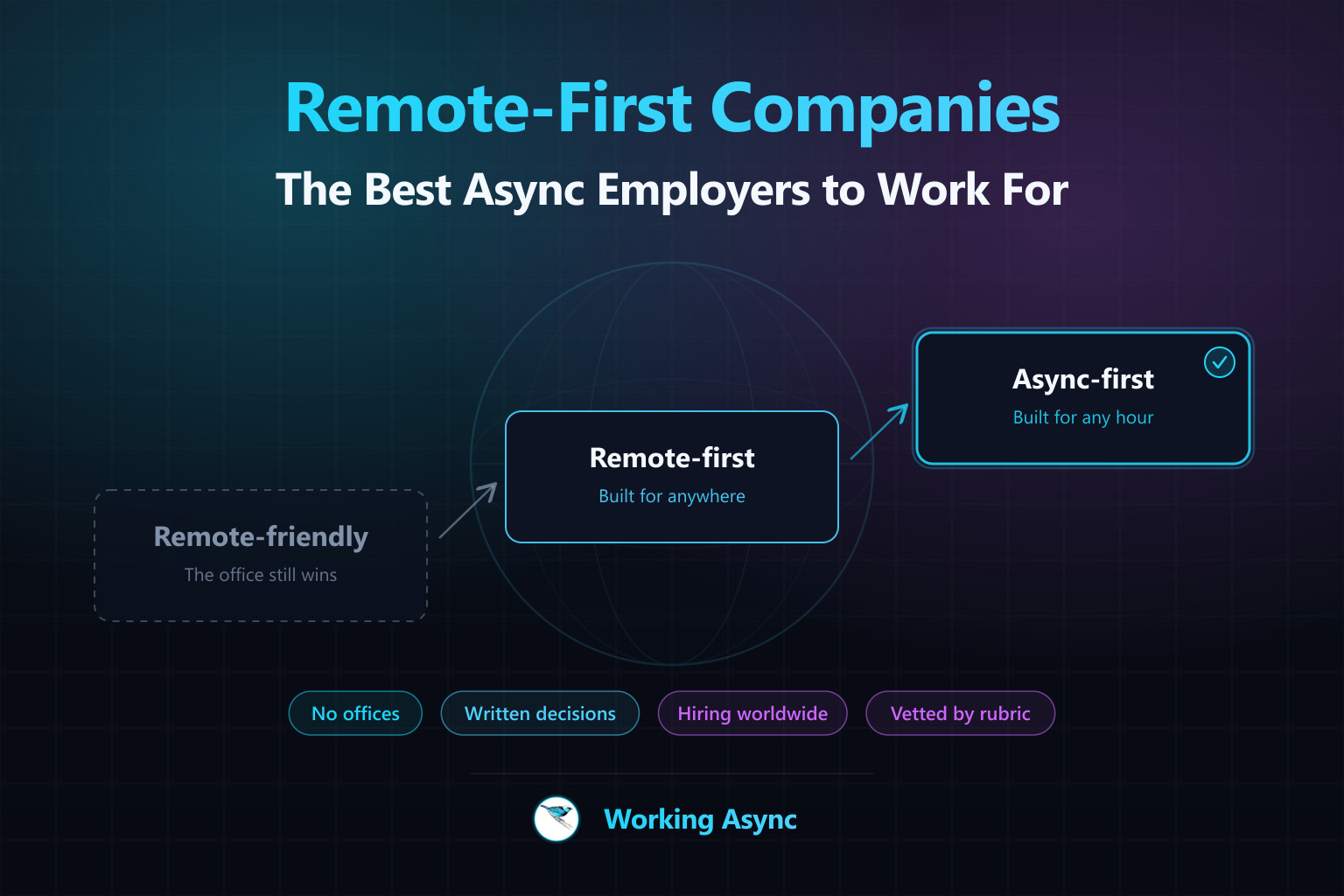
"We're remote-friendly" and "we're remote-first" sound like the same promise. They are not remotely the same job.
At one company, "remote" means you're allowed to dial into meetings designed for a conference room you're not in. At another, the entire operating system of the business — decisions, documentation, promotion paths — assumes nobody shares an office. Remote-first companies are the second kind, and the best of them go one step further: they run async, so the work doesn't even assume you share a time zone.
If you're hunting for the companies where remote work actually works, this guide is the map.
Remote-Friendly vs. Remote-First vs. Async-First
Think of it as three tiers of commitment:
| Tier | What it really means | What your day looks like |
|---|---|---|
| Remote-friendly | Remote is permitted; the office is still the center of gravity | You attend office-shaped meetings from home and miss hallway decisions |
| Remote-first | Distributed is the default; processes are built for it | Everything important is accessible from anywhere — but often still live, on a shared schedule |
| Async-first | Remote-first, plus work doesn't require shared hours | Decisions in documents, updates in writing, your schedule largely your own |
Fully remote companies — no offices at all — are usually at least remote-first out of necessity. But "fully remote" describes geography, not culture: the async tier is a separate, deliberate choice, and it's the one that changes your daily life most. If the distinction is new, our async versus synchronous comparison covers it in depth.
What the Genuinely Async Companies Have in Common
- A written source of truth. Handbooks, RFCs, decision logs — the company's brain lives in documents anyone can read, not in meetings you had to attend. GitLab's public handbook is the famous extreme: thousands of pages that let anyone, anywhere, act without asking.
- Meetings are the exception with a cost, not the default with momentum. Recurring calls get audited away; what remains has an agenda and produces notes.
- Wide-band or worldwide hiring. A company that hires across every time zone has structurally committed to async — it has no other way to function. Time-zone requirements in listings tell you the truth about the culture.
- Output over presence. Performance reviews reference shipped work and written contributions, not responsiveness or hours visible online.
These are the criteria behind our async rubric — the standard every company on the board is screened against.
Remote-First Companies Hiring Right Now
Every employer listed on Working Async is fully distributed and vetted for async culture. A sampling of who's hiring, and what makes each one worth a look:
GitLab
The reference implementation of all-remote work. No offices since founding, the public handbook, and async written culture applied at a scale of over a thousand people across dozens of countries. If you want to see how far the model goes, start here.
Remote.com and Oyster
Both build the infrastructure that makes global employment legal — and both practice what they sell, hiring their own teams across the world. Working at a global-employment platform means your employer's product is the reason your contract works.
Supabase
An open-source backend platform whose engineering culture grew out of open-source itself — public repos, written proposals, contributors on every continent. Async isn't a policy there; it's the upbringing.
DuckDuckGo
The privacy-focused search company has been fully distributed for over a decade — one of the quiet proofs that a consumer product used by millions can be built without an office.
Docker and Tether
Developer tooling and digital-asset infrastructure respectively — two very different businesses that both hire globally and run distributed, with deep engineering benches and roles that regularly span every region.
The board also includes Deel, Chili Piper, and Sporty Group — global-payroll, sales-software, and sports-technology companies with the same fully-distributed DNA. Roles across all of them span engineering, product, marketing, support, and beyond.
The Trade-Offs of Remote-First Life
With everything in life there are trade-offs, and the async tier asks real things of you:
Drawbacks:
- Writing is the job. Influence at an async company flows to people who write clearly and often. If you'd rather talk an idea through than draft it, you'll be swimming upstream.
- Belonging takes deliberate effort. No office means no ambient friendship. Good companies engineer connection — retreats, virtual socials — but you have to show up for it.
- Competition is global. The same worldwide hiring that opens these jobs to you opens them to everyone. Applications are a numbers game played against the whole planet.
- Autonomy cuts both ways. Nobody watches over your shoulder — which also means nobody notices when you're drowning unless you say so, in writing.
How to Get Hired at a Remote-First Company
- Apply in their medium. Async companies hire through writing — cover notes, take-home exercises, written Q&A. Treat every written artifact as the interview it is.
- Show async evidence. A documented project, a well-run open-source issue thread, a decision memo — proof you can drive work forward without a meeting is worth more than a polished call.
- Read the listing like an audit. Time-zone bands, meeting culture, documentation habits — the signals from our rubric work in both directions. Here's how to tell real flexibility from a perks-list promise.
- Interview them back. Ask how the last significant decision was made and where it's written down. The answer tells you which tier you're really joining.
Frequently Asked Questions
What is a remote-first company?
A company where distributed work is the default and every process — meetings, documentation, decisions, promotions — is designed for people who don't share an office. An office may exist, but it's a satellite, not the center.
What's the difference between remote-first and remote-friendly?
Remote-friendly permits remote work while the office stays the center of gravity; remote-first builds the company around distribution. In practice: at a remote-friendly company you join office meetings from home, while at a remote-first one there is no room you're missing.
Which companies are fully remote?
Well-known examples include GitLab, DuckDuckGo, Remote.com, Oyster, and Supabase — all fully distributed with no central office, and all listed on our vetted board alongside other async-first employers hiring across engineering, product, marketing, and support.
What is an async-first company?
A remote-first company that also removes the shared-schedule assumption: decisions happen in documents, updates in writing, and almost nothing requires you online at a specific hour. It's the tier where remote work stops imitating office work.
How do I get a job at a remote-first company?
Apply through writing and make it excellent, show evidence you can drive work asynchronously (documented projects, open-source threads, decision memos), and vet the company's real tier by asking how decisions get made and where they're written down.
Pick the Company by Its Operating System
A job title tells you what you'll do. The remote tier tells you how it will feel to do it, every single day. Choose the second as carefully as the first.
→ Meet the async-first companies on the board
→ Browse their open full-time roles
→ See the rubric we screen every employer against
The best remote companies aren't the ones that allow remote work. They're the ones built from it.