
Remote Jobs With Flexible Hours: Work When You Work Best
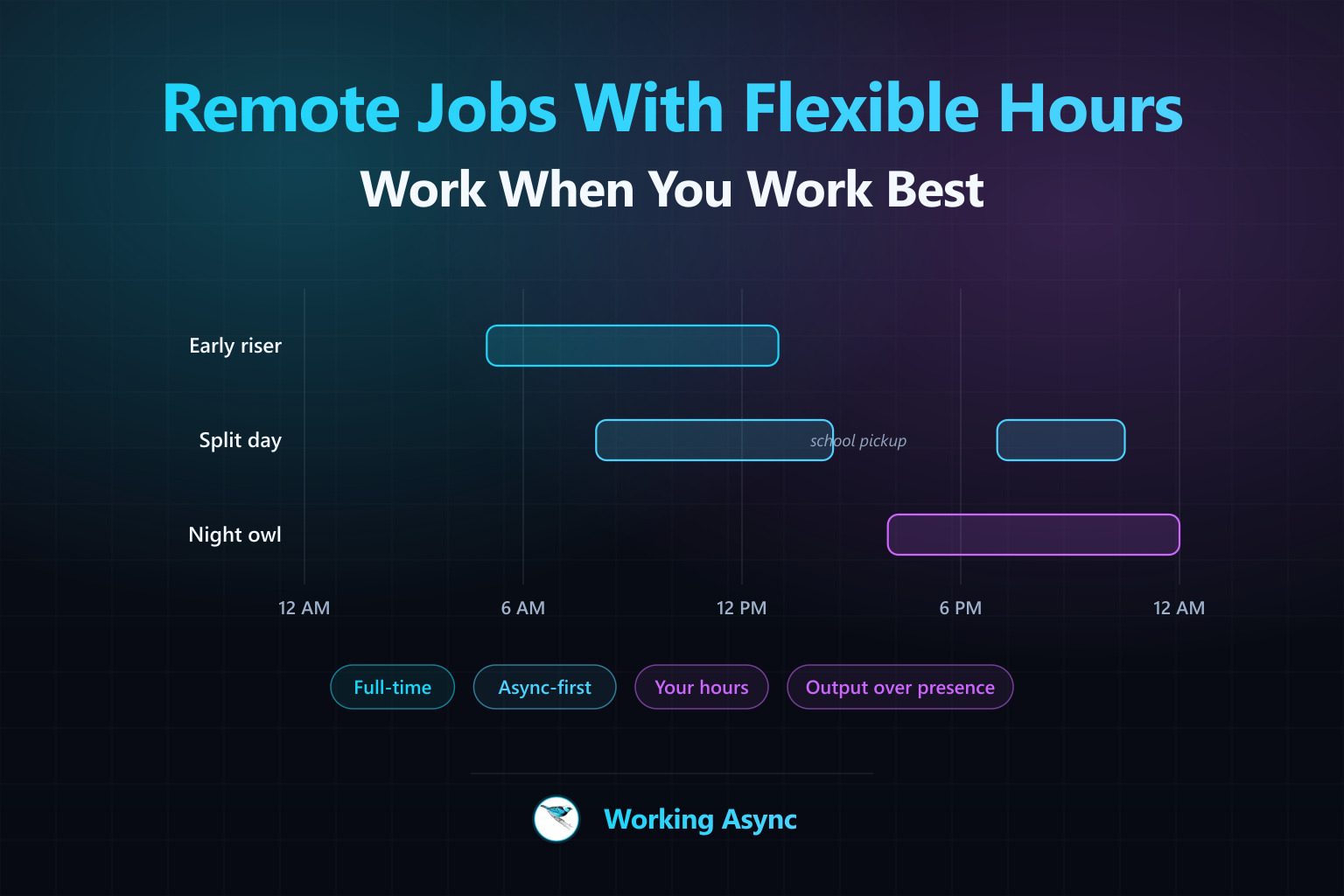
Remote work solved where you work. For most people, it did nothing about when.
The laptop moved to the kitchen table, but the 9-to-5 came with it — same standups, same "quick calls," same guilt about a doctor's appointment at 2 PM. If that's your experience, you're not really looking for another remote job. You're looking for remote jobs with flexible hours: full-time roles where the schedule bends around your life instead of the other way around.
Those jobs exist. The trick is that the real ones are rarely labeled "flexible hours" — that phrase appears in thousands of listings that still expect you online 9-to-6. What you actually want to find is a company whose way of working makes fixed hours unnecessary.
That distinction is the whole game.
What Does "Flexible Hours" Actually Mean in a Remote Job?
To put it simply, a flexible-hours job is one where you're measured on what you deliver, not on when you're visible. You'll see these roles advertised under many labels — flexible work from home jobs, remote jobs with a flexible schedule, jobs where you set your own hours — but whatever the wording, companies mean very different things by it, and they roughly fall into three models:
| Model | What it means | How flexible it really is |
|---|---|---|
| Flex window | You can shift a fixed schedule earlier or later — say, start anywhere between 7 and 10 AM. | Mildly. You choose the offset, not the shape, of your day. |
| Core hours | A few shared hours for meetings (e.g., 11 AM–2 PM), with the rest of the day yours to arrange. | Moderately. Good for overlap-heavy teams; the core still anchors your day. |
| Async-first | Work happens in writing, decisions live in documents, and almost nothing requires you at a specific hour. | Fully. You build your own schedule around your energy and your life. |
When a listing says "flexible hours," your first job is figuring out which of these it means. The rest of this guide is mostly about finding the third kind — because that's where flexibility stops being a perk and becomes how the company operates. If the term is new to you, start with what asynchronous communication actually is.
Flexible Hours Does Not Mean Fewer Hours
Worth saying plainly: these are full-time jobs. A flexible-hours role isn't a lighter workload or a side gig — it's the same salaried job, the same responsibilities, the same roughly 40 hours. What changes is that you decide where those hours land.
An engineer doing deep work from 6 to 11 AM and again after dinner is working full-time. So is a parent who logs off for school pickup every day and finishes in the evening. The output is what counts.
If what you're actually looking for is night work specifically, we've written a whole guide to finding legitimate overnight remote jobs — the two searches overlap more than you'd think, and the answer is the same: async-first companies.
Who Benefits Most From a Flexible Schedule Remote Job
A flexible schedule isn't equally valuable to everyone — it pays off most when your life or your energy doesn't fit the standard workday. A few people it changes everything for:
Parents and Caregivers
School pickup at 3 PM stops being a negotiation. You block it like any other commitment, and make the time up when the house is quiet.
Early Risers and Night Owls
Some people do their best thinking at 6 AM; others don't warm up until 9 PM. A fixed 9-to-5 wastes both. A flexible schedule lets you spend your sharpest hours on your hardest work.
People Living Outside Big-Company Time Zones
If the jobs you want cluster in US or European time zones and you don't live in either, flexibility is what makes the role livable. Async-first companies hire this way on purpose — many of the roles on our worldwide job board are open across every time zone precisely because the work doesn't wait for overlap.
Deep-Work People
Writers, engineers, designers, analysts — anyone whose best output comes from long uninterrupted stretches. When your calendar isn't diced into meeting-sized pieces, three focused hours can beat a full fragmented day.
People With a Life That Doesn't Fit Office Hours
Training for a marathon at midday. A weekly class. A long midweek hike. Energy and daylight when you actually want them. None of this should require negotiating with a manager, and at genuinely flexible companies, it doesn't.
Where Flexible Hours Actually Come From
Here's the uncomfortable truth about that "flexible working hours!" bullet in job listings: a perk can be revoked. A culture can't.
If a company runs on live meetings, instant Slack replies, and decisions made on calls, your "flexible schedule" collapses the first week — because everything important happens synchronously, and missing it has a cost. The flexibility was never structural. It was a favor.
Async-first companies are different because the work itself is built not to need you at a specific hour. Updates are written, not performed in standups. Decisions live in documents you can read when you wake up. Progress doesn't pause because a teammate is asleep. Companies like GitLab and Automattic have run this way at scale for years — it's a proven operating model, not an experiment.
That's why the reliable way to find a flexible-hours job is to stop searching for the phrase and start filtering for the culture. It's the entire reason Working Async exists: every company on the board is screened against our async rubric — a public standard for how async-friendly a workplace actually is — so "flexible" means something before you ever apply.
Jobs With Flexible Hours: Full-Time Roles by Category
Schedule flexibility follows the nature of the work: the more a role runs on written, self-directed output, the easier it is to do on your own hours. That's why the best flexible work from home jobs cluster in a handful of fields.
Software Engineering
The classic deep-work job. Code review, written RFCs, and CI pipelines are async by nature, which is why async engineering roles are the most common thing on our board.
Design and Product
Mockups, specs, and roadmaps are all artifacts someone can review hours after you made them. Feedback loops in design and product work well in writing — often better, because reviewers get time to think.
Writing, Content, and Marketing
Documentation, blog posts, campaigns, SEO — marketing and content roles are judged almost entirely on the finished work, which makes them naturally schedule-agnostic.
Operations and Data
Reporting, analysis, tooling, process work — much of operations and data science is heads-down production that slots into whatever hours suit you.
Customer Support — With an Honest Caveat
Support is the one category where hours are often genuinely fixed, because coverage windows exist for a reason. That said, global async companies staff support across time zones, so remote support roles frequently offer a choice of windows — including evening and overnight ones — even when the window itself is set.
The Trade-Offs of Flexible Work From Home Jobs
With everything in life there are trade-offs, and a flexible schedule has real ones. Honesty first:
Drawbacks:
- You become your own manager. Nobody structures your day for you. If you struggle to start without external pressure, total freedom can be harder than a fixed schedule, not easier.
- Boundaries blur. When you can work at any hour, it's easy to end up working at every hour. You have to build your own stopping lines.
- Less live time with teammates. Fewer meetings is the point, but it also means fewer spontaneous moments. Good async companies compensate with deliberate social time; you'll still feel the difference.
- Writing becomes a core skill. When work happens in documents, people who communicate clearly in writing have an advantage. If that's not you yet, expect a learning curve.
- Not every hour is yours everywhere. Even async-first companies occasionally need a shared call. "Flexible" means the default is yours — not that overlap never happens.
If you read that list and feel more excited than nervous, you're probably the kind of person this way of working suits.
How to Tell If a Remote Job's Flexible Hours Are Real
Every company says it's flexible. Here's how to check before you're three weeks into the job.
Green flags:
- The listing says async-first or "async" explicitly — and describes how (written updates, meeting-light, documentation culture), not just as a buzzword.
- The role is open across a wide time-zone range, or worldwide. A company that hires across twelve time zones has already solved working without overlap.
- They mention documents, handbooks, or written decision-making. Writing culture is the machinery that makes flexible hours real.
- The interview process itself is async-friendly — take-home exercises, written questions, recorded intros.
Red flags:
- "Flexible hours" in the perks list, but "must be available 9 AM–6 PM EST" in the requirements. The requirements are the truth.
- "Fast-paced environment" paired with expectations of instant responses. That's a synchronous culture describing itself honestly.
- A daily standup at a fixed time plus several recurring meetings. Count the standing meetings in the listing; each one is an anchor on your day.
And in the interview, ask directly: "Walk me through how a typical decision gets made — who's in the room, and what happens in writing?" The answer tells you more than any perks list. If you want a structured way to score what you hear, our rubric is exactly that checklist.
Frequently Asked Questions
Are flexible hours the same as working fewer hours?
No. Flexible-hours roles are full-time jobs with a normal full-time workload — flexibility changes when you work, not how much. You're rearranging the same hours around your life, energy, and time zone.
What remote jobs let you choose your own hours?
Roles built on written, self-directed output: software engineering, design, product, writing and marketing, operations, and data work. Support and success roles can qualify too when a global team offers a choice of coverage windows. The common thread is an async-first employer, not the job title.
Do remote jobs with flexible hours pay less?
No — pay tracks the role and your skills, not the schedule. These are the same full-time engineering, design, marketing, and operations jobs you'd find anywhere; async-first companies compete for the same talent at market salaries. Flexibility is part of how they compete.
What does "core hours" mean in a job listing?
A daily window — often three or four hours — when everyone is expected online for meetings and live collaboration, with the rest of the day scheduled however you like. It's a middle ground: more flexible than a fixed 9-to-5, less flexible than a fully async company where no daily window exists at all.
Can I work nights or early mornings in a flexible-hours job?
At a genuinely async-first company, usually yes — if nothing requires you at a fixed hour, a night-heavy or dawn-heavy schedule is just another shape for the same full-time job. Check the listing's time-zone and overlap requirements, since some roles still expect a few shared hours.
How do I know if a company really offers flexible hours?
Read the requirements, not the perks. Wide or worldwide time-zone eligibility, an explicit async or documentation culture, and a meeting-light calendar are the reliable signals; a required daily availability window is the reliable counter-signal. Then ask in the interview how decisions actually get made.
Your Hours Are Part of the Job Description
Where you work stopped being fixed years ago. When you work is next — and the companies that have figured this out are hiring now.
→ Browse full-time roles at async-first companies
→ See the companies that work this way
→ Understand async vs. sync before your next interview
Work when you work best. The right company won't just allow it — they're built for it.