
Weekend Remote Jobs: Full-Time Work From Home
Search for weekend work from home and you get two kinds of result: gig apps offering a few Saturday hours of surveys or tutoring, and shift listings for a warehouse across town. Neither is a career.
Weekend remote jobs — real, salaried, full-time roles where Saturday and Sunday are working days — exist, and there are more of them than the search results suggest. They're just filed under other names: "weekend coverage," "Wednesday-to-Sunday," "rotating weekends," or, most often, no schedule at all, because the company genuinely doesn't care which days you work.
If your weekdays belong to something else — a partner's shifts, childcare, a business you're building, or simply a preference for quiet Tuesday mornings — this guide is about finding full-time work that fits around it.
What Counts as a Weekend Work From Home Job?
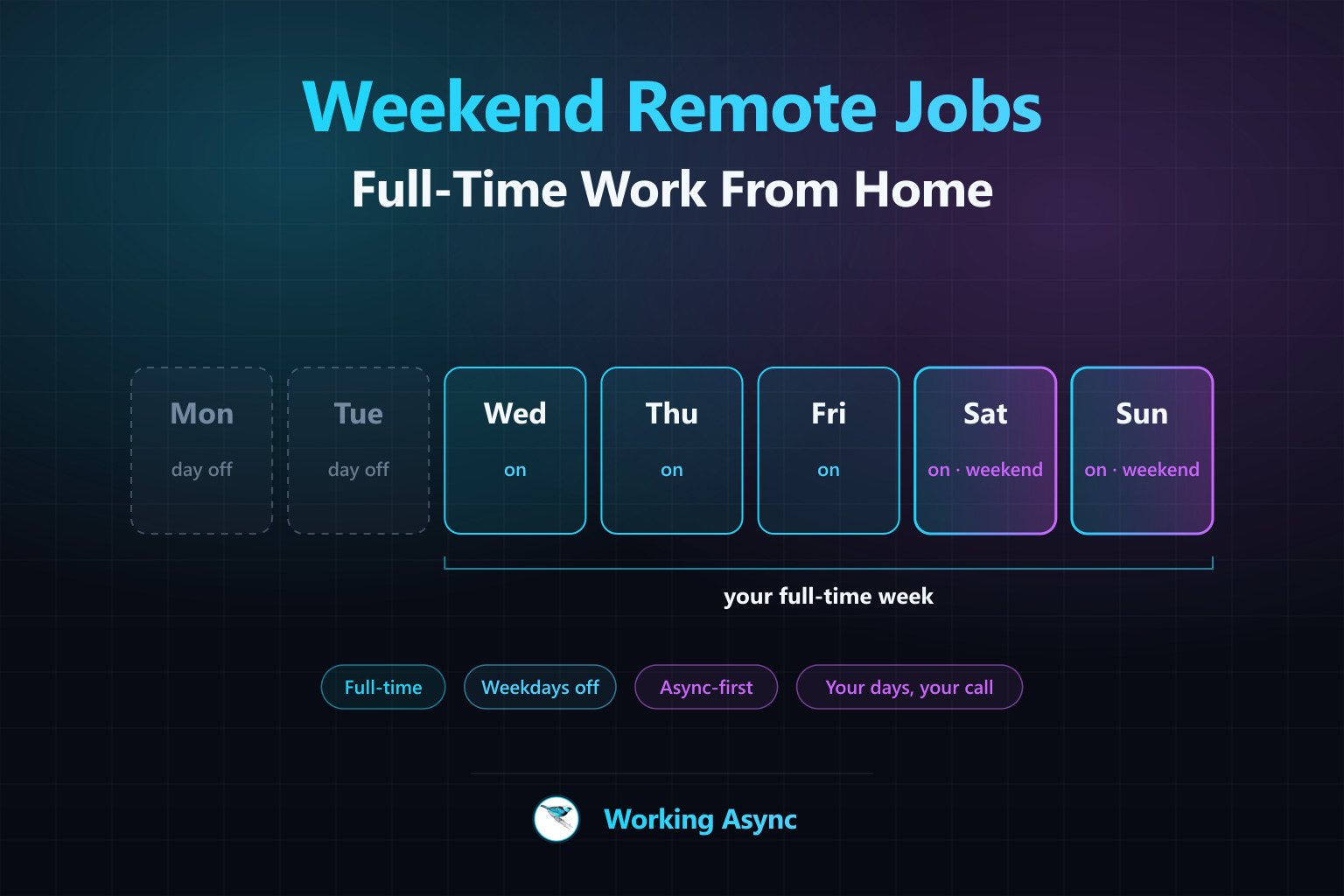
To put it simply, a weekend work from home job is a full-time remote role where the weekend is part of your regular working week rather than your time off. Two shapes are common:
| Schedule | Typical week | Who it suits |
|---|---|---|
| Fixed weekend coverage | Wednesday–Sunday, or Thursday–Monday, with two weekdays off | People who want a predictable schedule and a business that needs weekend staff |
| Flexible days at an async company | Any five days that add up to a full-time week — often including one or both weekend days | People whose weekday commitments shift week to week |
What both have in common: the hours are full-time. A weekend schedule doesn't shrink the job — it moves it. If you've been looking at evening or overnight schedules for the same reason, our guides to evening remote jobs and overnight remote jobs cover those shapes; this one is about which days you work, not which hours.
Weekend Jobs From Home Can Be Full-Time Careers
The biggest myth to clear up: working weekends doesn't mean working small. Support engineers, operations analysts, community managers, and account managers on a Wednesday-to-Sunday rota earn the same salary and sit on the same career track as their Monday-to-Friday colleagues.
The gig listings that dominate weekend job searches have crowded out the real thing. What you're looking for is a full-time employer whose structure makes weekend days possible — and there are two kinds.
Path One: Weekend Shift Jobs With Fixed Saturday and Sunday Coverage
The first path is the classic weekend shift: a role with a stated Saturday-and-Sunday schedule, staffed because the business genuinely operates seven days a week. Customers file tickets on Sunday. Systems fail at 2 PM on a Saturday. Someone has to be there — and increasingly, that someone works from home.
Where these roles cluster:
Weekend Customer Service Jobs Remote Teams Actually Staff
Support is the largest source of fixed weekend remote work. Global companies run help desks and chat queues seven days a week, and a Wednesday-to-Sunday week is a standard rota rather than a special request. Full-time support roles include proper onboarding, a salary, and a path into support engineering, success, or operations — none of which the gig version offers. Our post on remote customer service jobs goes deeper on what the good ones look like, and the customer support hub lists what's open now.
Remote Weekend Jobs in Operations, Monitoring and Moderation
Anything that watches a live system or a live community needs weekend eyes: incident response and on-call engineering, trust-and-safety and content moderation, payments and fraud operations, marketplace operations, and community management. These roles often run a rotating weekend — one or two weekends a month with weekdays off in exchange — rather than a permanent one, and the listing will say which. Browse the operations hub and the engineering hub for roles where on-call or coverage is part of the job.
The honest limitation of Path One: the schedule is set by the business, not by you. That's fine if predictability is what you want. If what you actually want is control over which days you work, keep reading.
Path Two: Async Companies Where Weekend Work From Home Is Your Call
The second path doesn't advertise weekend work at all, which is why most people miss it.
At an async-first company, collaboration happens in writing — documents, threads, recorded walkthroughs — rather than in live meetings. Teammates read and respond in their own hours. Nobody is waiting on you at a fixed time, so the company has very little reason to care whether your five working days are Monday-to-Friday or Wednesday-to-Sunday.
That's what turns a weekend schedule from a favor into a default. You're not asking for an exception; you're using the way the company already works.
A few things that are true at genuinely async-first companies:
- Your Sunday output lands like any other day's. A pull request, a spec, or a report written on Saturday is waiting for colleagues Monday morning, exactly as their Friday work was waiting for you.
- Meetings are rare and often recorded. The few live conversations that do happen tend to be scheduled, recorded, and optional to attend live — so a Tuesday off doesn't mean missing the decision.
- Overlap is stated, not assumed. Partially async companies keep a short core-hours window on working days; fully async companies don't. Either way, the listing tells you.
Companies like GitLab and Automattic have run this way at scale for years. Every company on Working Async is screened against our async rubric before it's listed, and our flexible-hours job board lists every open role with the fully async companies first — the ones where a weekend-inclusive week is least likely to raise an eyebrow.
Who Looks for Remote Jobs Nights and Weekends
A weekend-inclusive week isn't for everyone — but for some people it fits better than the standard week ever did.
Parents Splitting Childcare Across the Week
When one partner works Monday-to-Friday, a Wednesday-to-Sunday schedule means the kids always have a parent home and childcare drops to three days a week — or zero. It's the same logic that makes remote jobs popular with stay-at-home parents, applied to the calendar instead of the clock.
People Building Something on Weekdays
Weekdays are when banks, suppliers, clients, and government offices are open. If you're building a business, studying, or renovating a house, working weekends and taking Monday and Tuesday off gives you two full weekdays when the rest of the world is reachable.
Anyone Who Wants Weekdays Off
Empty trails, quiet museums, off-peak flights, no queue at the DMV. A Tuesday off is worth more than a Saturday off in almost every practical sense — and at an async company, choosing it costs you nothing.
High Paying Weekend Jobs: What Remote Weekend Work Pays
Here's the part the gig listings get most wrong. A full-time weekend remote job pays what the role pays. A support engineer on a Wednesday-to-Sunday rota earns a support engineer's salary; an operations analyst who takes Mondays off earns an operations analyst's salary. The calendar doesn't change the band.
Some fixed-coverage roles add a weekend or shift differential on top of base pay — common in support, incident response, and moderation — and the listing will say so. At async-first companies there's no differential because there's no "weekend shift": you're a full-time employee working a normal week on the days you chose.
What matters more for pay is the role and the company. Our guide to high-paying remote jobs covers which fields pay best; every one of them exists in a weekend-inclusive shape at the right employer. Where a company discloses a range, it appears on the listing — we only quote what listings state.
The Trade-Offs of Weekend Jobs Online
With everything in life there are trade-offs, and working weekends has real ones. Honesty first:
Drawbacks:
- You're out of sync with most people you know. Friends and family are off when you're on. Weddings, kids' matches, and Sunday lunches need planning rather than assuming. This is the one people underestimate.
- Fixed-coverage roles are fixed. On Path One, swapping a Saturday usually means finding cover. The predictability that makes the schedule work also makes it rigid.
- Async companies still have working-day rhythms. Even at a fully async company, most colleagues work weekdays, so your Sunday is quiet in both directions — great for deep work, less great if you thrive on live back-and-forth.
- Boundaries blur faster. When your days off are the days everyone else is working, it's easy to "just check in." You have to protect your Monday as fiercely as others protect their Sunday.
- Some roles genuinely can't. Sales roles scoped to a territory, roles with a hard daily overlap window, or anything tied to a client's business hours won't flex to weekends however async the company is. The listing's requirements are the truth.
If you read that list and think the quiet weekdays are worth it, this schedule will probably suit you. If the social cost worries you, a rotating weekend — one or two a month — is a reasonable middle path.
How to Find Legitimate Weekend Remote Jobs
The weekend job market is thick with things that aren't jobs. Here's how to search for the real ones.
For fixed-coverage roles (Path One):
- Search the role, not the schedule. "Support engineer," "trust and safety," "incident response," and "community manager" surface full-time jobs; "weekend job" surfaces gigs.
- Read the schedule line in the requirements. "Wednesday–Sunday," "includes weekends," or "rotating weekend coverage" tells you it's structural. A vague "flexible" tells you nothing.
- Check for a salary, benefits, and a manager. If the listing quotes an hourly rate with no employer, no team, and no onboarding, it's a gig.
For flexible-days roles at async companies (Path Two):
- Filter for the culture, not the phrase. Start from companies that describe themselves as async-first, handbook-driven, or meeting-light — that's the machinery that makes flexible days real. Our company directory is a shortcut.
- Look for wide or worldwide time-zone eligibility. A company that hires across twelve time zones has already solved working without daily overlap; roles on our worldwide board are the clearest example.
- Ask directly in the interview: "If I worked Wednesday to Sunday, what would break?" A good async company can answer specifically — usually "nothing, as long as you're in the overlap window on working days." A synchronous one will hedge.
Red flags on either path:
- Pay for training, equipment, or "background checks" before you start. Real employers pay you.
- "Weekend job" listings with no company name, no role title, and a promise of hundreds a day.
- "Flexible schedule" in the perks list, but "must be available 9–6 Monday to Friday" in the requirements. The requirements win.
Frequently Asked Questions
Are there full-time weekend remote jobs?
Yes. Fixed weekend-coverage roles (Wednesday-to-Sunday and similar rotas) are standard in support, operations, moderation, and incident response, and they're full-time salaried jobs. At async-first companies, any five-day week that includes the weekend is simply a normal full-time schedule. Both are far more common than the gig listings that dominate weekend job searches suggest.
Can I work from home weekends only?
Two days can't hold a full-time week, so a Saturday-and-Sunday-only schedule isn’t a full-time job — and not what Working Async lists, since every role on the board is full-time. What's realistic is a full-time schedule where the weekend is included and two weekdays are off instead: Wednesday-to-Sunday at a coverage role, or any five days you choose at an async-first company.
Do weekend remote jobs pay more?
Not by default. Pay follows the role, not the calendar. Some fixed-coverage roles add a weekend or shift differential on top of base salary, and the listing will say so if they do. At async-first companies there's no premium because there's no shift — you're working a standard full-time week on the days you picked.
Are weekend remote jobs legit, or mostly scams?
The full-time ones are legitimate jobs at real companies. The scams concentrate around the word "weekend" itself: listings with no employer name, hourly rates with no team or manager, and requests to pay for training or equipment up front. Search by role rather than by schedule and most of the noise disappears.
Can I combine evening and weekend remote jobs into one schedule?
At a fully async company, often yes — if nothing requires you at a fixed hour on a fixed day, a Wednesday-to-Sunday week worked mostly in the afternoons and evenings is just another shape for the same full-time job. Check the listing's overlap requirements, since partially async roles still expect a few shared hours on working days.
How do I ask a company about working weekends without sounding difficult?
Ask about how the work flows, not about permission: "How do decisions get made — live or in writing?" and "What happens if someone's offline on a Tuesday?" A genuinely async company answers those easily, and the answer tells you whether a weekend-inclusive week would work before you ever have to request it.
Your Week Doesn't Have to Start on Monday
The five-day, Monday-to-Friday week is a default, not a law. Companies that need weekend coverage have always hired for it; companies that work asynchronously have quietly stopped caring which days you pick.
Either way, the job is full-time, the salary is real, and your Tuesdays are yours.
→ Browse full-time remote jobs with flexible hours
→ See the async-first companies hiring now
→ Learn how flexible hours really work in a remote job
Work the week that fits your life. The right company won't just allow it — they're built for it.