
Evening Remote Jobs: Full-Time Work After 5 PM
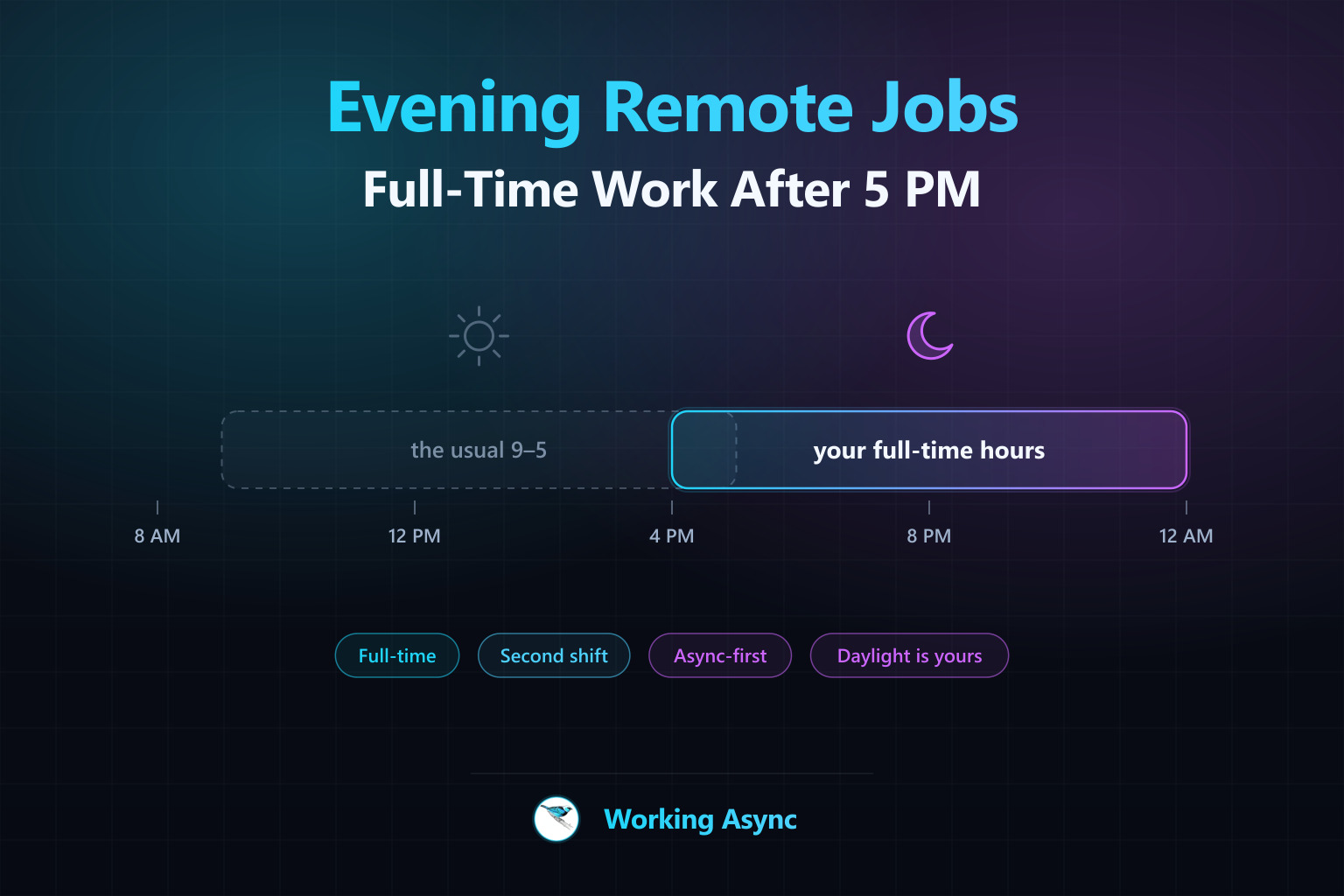
Search for evening work from home and you'll mostly find gig listings — a few hours of tutoring here, some survey-taking there. It leaves the impression that working evenings means working small.
It doesn't. Evening remote jobs — real, salaried, full-time roles worked mostly after 5 PM — exist in growing numbers. They're just listed under other names: "second shift," "evening coverage," or most often, no shift at all, because the company simply doesn't care when you work.
If your days belong to something else — family, daylight, another life you're building — this guide is about finding a career that starts when the office lights go off.
What Counts as an Evening Remote Job?
To put it simply, an evening remote job is a full-time role worked roughly between late afternoon and midnight — commonly 4 PM to midnight or 5 PM to 1 AM. In shift terms it's the second shift: after the standard business day, before the overnight crew. Listings scatter these roles across many labels — evening work from home jobs, work from home evening jobs, evening shift jobs, second shift remote jobs — so search all of them.
That places it between two neighbors worth knowing about:
| Schedule | Typical hours | Who it suits |
|---|---|---|
| Evening / second shift | 4 PM – midnight | People whose mornings and afternoons are spoken for — and natural late-afternoon peakers |
| Night shift | 7 PM – 3 AM | People who want quiet working hours but still want some evening overlap with family |
| Overnight / third shift | 10 PM – 8 AM | True night owls and people aligning with far-away time zones |
This post covers the first row. If you're drawn to the deeper end of the night, our guide to overnight remote jobs covers night shift and third-shift work in detail.
Evening Work From Home Jobs Can Be Full-Time Careers
The biggest myth to clear up: an evening schedule doesn't make a job smaller. A full-time role worked 4 PM to midnight is the same job, same salary, and same career track as one worked 9 to 5.
The gig listings dominating evening job searches have simply crowded out the real thing. What you're looking for is a full-time employer whose structure makes evening hours possible — and there are two kinds.
Path One: Second Shift Remote Jobs (Fixed Evening Coverage)
The first path is the classic second shift remote job: a role with a stated evening window, staffed because the business genuinely needs people working evenings — their customers don't stop at 5 PM.
Where the fixed evening shifts are:
- Customer support. Evening customer service jobs are the most common evening remote work by far. Global products need coverage into the evening in every market, so support teams staff dedicated 4 PM–midnight windows. Evening windows also get fewer applicants than daytime ones — which means less competition for you.
- Technical support and IT helpdesk. Same coverage logic, more technical work, generally higher pay.
- Trust & safety and moderation. Platforms are busiest when people are home from work — which is exactly your shift.
- Healthcare support. Scheduling, triage lines, and medical documentation run well into the evening.
These roles have fixed hours — the flexibility is in which window you claim, not in moving it day to day. Browse remote customer support roles to see what coverage-based openings look like.
Path Two: Async Companies — Evening Shift Jobs Without the Shift
The second path is bigger, pays better, and almost never says "evening" in the listing.
At an async-first company, work happens in writing — decisions in documents, updates you can read whenever you sit down, almost nothing requiring you at a specific hour. Nobody assigns you an evening shift. You just… work evenings, because nothing stops you.
A designer who spends daylight with their kids and opens the laptop at 8 PM is not on "second shift." They're doing the same full-time design job as their teammate in another time zone who works at dawn. The company measures the work, not the clock.
This is the path most worth pursuing, because it opens the entire skilled-role market to evening workers: engineering, product, marketing and content, operations — careers, not coverage. If the async way of working is new to you, start with what asynchronous communication actually is.
There's also a quiet third variant: work for a company headquartered far to your west. For someone in Europe, a US company's ordinary business day lands from late afternoon to midnight local time — an evening job with no shift label at all. Many roles on our worldwide board work exactly this way.
Who Thrives on an Evening Schedule
Parents Splitting the Day
One parent takes mornings and school runs; the evening worker takes over after dinner. Two careers, no daycare bill for the afternoon hours.
People Who Peak Late
Not everyone is sharpest at 9 AM. If your focus arrives at 6 PM, an evening schedule puts your best hours on your hardest work instead of on your commute home.
People Who Want Their Daylight Back
Morning hikes, midday gym sessions, errands when stores are empty — and in winter, the freedom to step outside for a break while the sun is actually out. An evening schedule trades the busiest hours of the day for the quietest.
Builders With a Daytime Project
Renovating a house, running a small farm, finishing a degree program's daytime obligations — a full-time evening job pays for what you're building during the day, without taking those hours away from it.
What Do Evening Remote Jobs Pay?
The honest answer: the same as their daytime equivalents. Remote evening roles rarely carry a shift premium — pay follows the skill, not the clock.
The real financial edge is subtler. Evening coverage windows attract fewer applicants, so you're competing against a smaller field for the same salary band. And on the async path, "evening" isn't a category at all — you're paid as an engineer or marketer, full stop.
The Trade-Offs of Working Evenings From Home
With everything in life there are trade-offs, and evenings have real ones:
Drawbacks:
- Your evenings are the social default. Dinners, kids' bedtimes, games, gatherings — most of the world socializes exactly when you'd be working. This is the big one; be honest with yourself about it.
- Partner overlap shrinks. If your partner works days, your shared waking hours compress to mornings and weekends. Couples make it work, but it takes intention.
- Fixed second shifts are fixed. On the coverage path, you can't slide your window for a Thursday event. (The async path can — which is a reason to prefer it.)
- The transition to sleep is real. Logging off at midnight and going straight to bed doesn't work for everyone; many evening workers need a wind-down hour, making it effectively a 1 AM schedule.
How to Find a Legitimate Evening Remote Job
Because evening searches are thick with gig work and worse, filter hard:
Green flags:
- A salaried, full-time role where the evening window is stated plainly in the listing — with benefits listed like any other job.
- Or: an async-first company with wide time-zone eligibility and a written, meeting-light culture. That's the "build your own evening" path — here's how to tell real schedule flexibility from a perks-list promise.
- A real company you can research, with a careers page and named humans.
Red flags:
- "Earn $40/hour from your couch tonight!" — urgency plus vagueness is the signature of evening-job scams.
- Any request for money, equipment deposits, or "training fees." Employers pay you.
- Pay quoted only per-task or per-hour with no employment structure — that's the gig economy wearing a job costume.
Every company listed on Working Async is screened against our async rubric, so the flexible path is pre-filtered for you — the roles are full-time, and the cultures genuinely support working the hours you choose.
Frequently Asked Questions
Are evening remote jobs full-time?
The good ones are. Evening search results skew toward gig work, but salaried second-shift coverage roles and async-first jobs worked on an evening schedule are ordinary full-time employment — same salary, benefits, and career track as daytime equivalents.
What is a second shift remote job?
A full-time role covering the window after standard business hours — typically 4 PM to midnight. It's most common in customer support, technical support, and moderation, where companies need staffed coverage into the evening across their markets.
What evening jobs can I do from home?
Two families: coverage roles with stated evening windows (support, helpdesk, trust and safety, healthcare support), and any writing-based skilled role — engineering, design, marketing, operations — at an async-first company where you're free to work your full-time hours in the evening.
Do evening remote jobs pay more than day jobs?
Usually the same. Remote roles rarely carry the shift differentials of in-person evening work. Your advantage is competition, not premium: evening windows draw fewer applicants, and on the async path you're simply paid the market rate for your role.
Can I work evenings at a regular remote company?
Only if its culture allows it. A company that runs on daytime meetings and instant replies will pull you back into business hours no matter what the perks list says. Look for async-first companies or roles hiring across wide time-zone ranges — there, an evening schedule is just another shape for the same job.
The 9-to-5 Was Always Just a Default
Evening workers aren't asking for an unusual favor — they're just scheduling the same full-time work where it fits their life. The companies built around output instead of presence have already said yes.
→ Browse full-time roles at async-first companies
→ Meet the companies that don't watch the clock
Your career doesn't need the sun up. It needs the work done.