
What Is Asynchronous Work? A Plain-English Guide
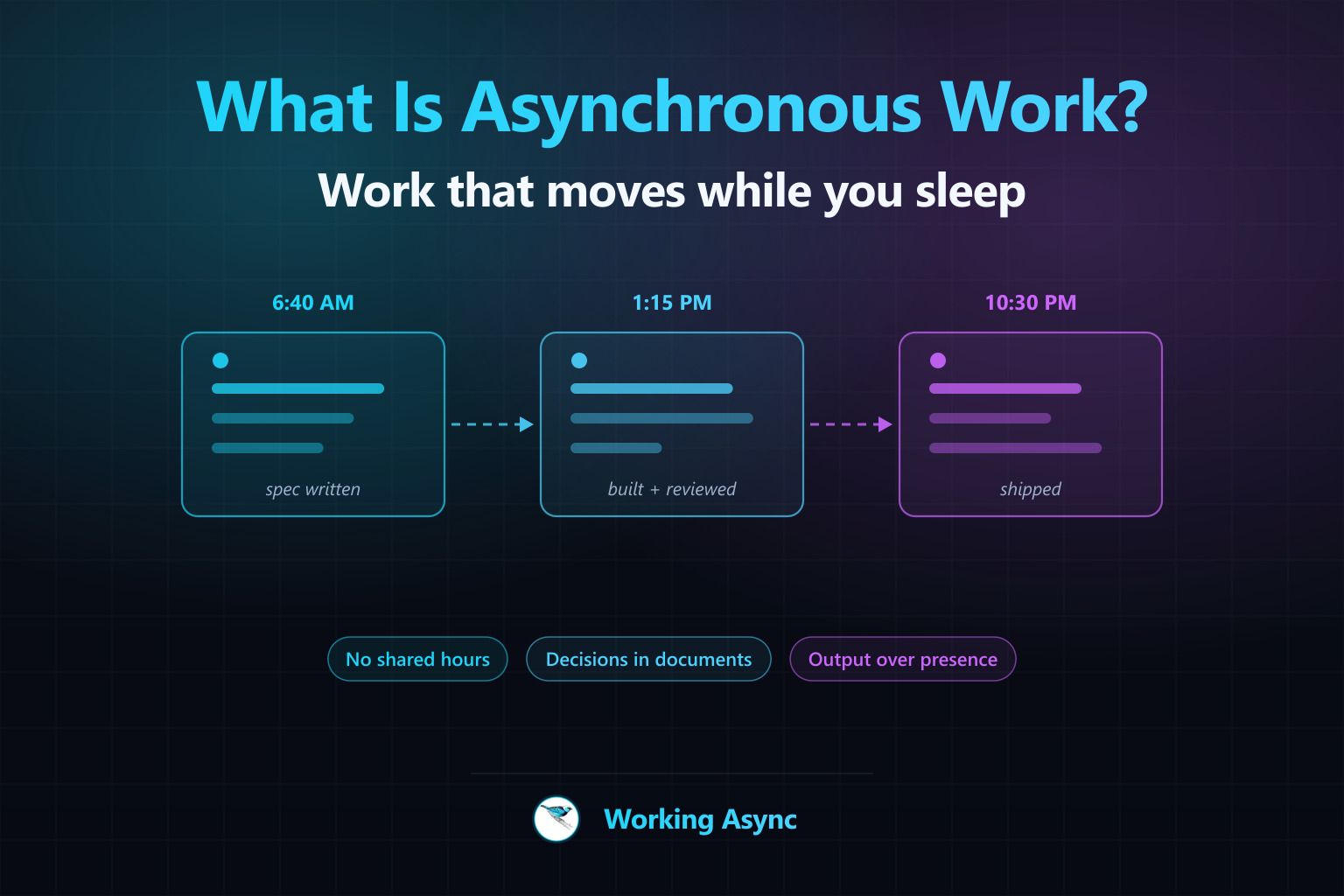
Most jobs are built on a hidden assumption: that work only happens when everyone is present at the same time. The meeting starts at 10. The question gets answered when you catch someone at their desk. The decision waits for Thursday's call.
Asynchronous work removes that assumption. To put it simply, async work is a way of working where progress doesn't depend on people being online together — you do your part, hand it off in writing, and the next person picks it up on their own schedule.
That one change reshapes the entire workday.
What Is Asynchronous Work?
Asynchronous work (or async work) is a working model where collaboration happens through artifacts — documents, recorded videos, code reviews, written updates — instead of through simultaneous presence. You communicate in ways that don't demand an immediate response, and your teammates respond when they're at their best, not when a calendar says so.
The communication layer underneath this has its own name, and we've covered it in depth: asynchronous communication. Async work is what happens when a company builds its whole operating model on top of it — hiring, decisions, and delivery all designed so that shared hours are optional.
The goal of async work is simple: measure output, not presence.
Asynchronous Work vs. Remote Work — Not the Same Thing
People often use these interchangeably. They shouldn't.
| Remote work | Asynchronous work | |
|---|---|---|
| What it changes | Where you work | When you work |
| Meetings | Still the default — just on video | The exception; decisions live in documents |
| Your schedule | Usually still 9–5 in someone's time zone | Largely your own, built around a few agreed touchpoints |
| What's measured | Often still presence and responsiveness | Shipped work and written contributions |
A company can be fully remote and still deeply synchronous — eight hours of video calls is office culture with worse chairs. And the reverse is true: async is the tier of remote work where the job stops imitating the office. Our guide to remote-first companies breaks down those tiers in detail.
What a Day of Async Work Actually Looks Like
Here's a realistic day for a product designer at an async-first company, working full-time from her own time zone:
- Morning: She opens the team's project doc, reads what her engineer teammate in another time zone shipped overnight, and leaves written feedback on two design questions he raised.
- Midday: Deep work — three uninterrupted hours on new screens. No standup, because her written update from yesterday already told everyone what she's doing. She takes a real lunch and picks her kids up from school.
- Afternoon: She records a five-minute Loom walking through the new flow, posts it with the Figma link, and tags the two people whose input she needs — by tomorrow, not by 3 PM.
- End of day: A short written update: what shipped, what's blocked, what's next. By the time she logs off, teammates in earlier time zones are already picking up where she left off.
Notice what's missing: nobody watched her work, and nothing waited on a meeting.
The tools are ordinary — Slack threads, Notion or Google Docs, GitHub, Loom. What's different is the default: written and recorded first, live only when it genuinely helps.
The Benefits of Asynchronous Work
Benefits:
- Your hours follow your life, not the other way around. Early risers start at 6; night owls do their best work after dinner; parents split the day around school runs. Full-time output, your shape. (More on how that flexibility works in practice in our guide to remote jobs with flexible hours.)
- Deep work becomes normal. Long, uninterrupted stretches are the default state of your day instead of something you defend on a blocked-off calendar.
- Decisions get better paper trails. When choices are made in writing, context survives. New teammates can read their way to competence instead of scheduling ten onboarding calls.
- The whole world is your job market. Companies that work async can hire across every time zone — which means their worldwide openings are open to you, wherever you are.
The Drawbacks of Asynchronous Work
With everything in life there are trade-offs when making a decision, and async work asks real things of you:
Drawbacks:
- Answers are slower. A question that takes thirty seconds at a desk might wait hours for a reply. Async workers learn to batch questions, anticipate blockers, and always have a second task ready.
- Writing is the job. Influence flows to people who write clearly. If drafting a paragraph feels harder than saying it out loud, you'll be practicing — a lot.
- Isolation is real if you let it be. No shared hours means no ambient social contact. Good async companies engineer connection deliberately; you still have to show up for it.
- It requires discipline. Nobody structures your day for you. That freedom is the perk and the test, in equal measure.
None of these are reasons to avoid async work. They're the skills the model runs on — and every one of them is learnable.
How to Find Asynchronous Work
Very few listings say "asynchronous" in the title. Here's how to find the real thing:
- Target async-first companies, not async-labeled jobs. At a company that runs async, every role is an async role. Start with the vetted companies on Working Async — each one is screened against our async rubric before it's listed.
- Read listings for time-zone tells. "Worldwide" or a wide time-zone band signals a company structurally committed to async. "Core hours 9–5 EST" tells you the opposite, no matter what the culture page says.
- Look in async-heavy fields first. Engineering, product, design, and marketing translate naturally to documented, hand-off-friendly work.
- Apply in writing like it's the interview — because it is. Async companies hire through written artifacts. A clear, self-contained application demonstrates the exact skill they're hiring for.
Frequently Asked Questions
What does asynchronous work mean?
It means work that moves forward without everyone being online at the same time. You collaborate through documents, written updates, and recorded video, and teammates respond on their own schedules — so progress doesn't depend on shared hours.
Is asynchronous work the same as remote work?
No. Remote work changes where you work; async work changes when. Plenty of remote companies still run on synchronous meetings and a fixed 9–5. Async companies remove the shared-schedule assumption itself.
Are asynchronous jobs full-time?
Yes — async is a way of structuring full-time work, not a reduced commitment. You work full-time hours; you just have far more say over which hours they are.
Do async companies have any meetings?
Usually a few, and on purpose. Most async-first teams keep rare, high-value live sessions — planning kickoffs, one-on-ones, social calls — while everything that can be a document becomes one.
What skills do I need for asynchronous work?
Clear writing above all, plus self-management, proactive communication (surfacing blockers before someone asks), and comfort with tools like Slack, Notion, GitHub, and Loom. All of them improve quickly with practice.
Work That Waits for You
Asynchronous work isn't a perk bolted onto a normal job. It's a different contract: the company measures what you produce, and in exchange, your hours belong to you.
If that's the contract you want, start where the async companies already are — browse the vetted employers and their open full-time roles on Working Async.
Async isn't working less. It's working when you work best.